

Executive Summary:
When evaluating poultry manure treatment, modern egg producers face a critical question: Are you trying to enter the commercial fertilizer business, or do you simply need to stabilize and reduce manure volume with minimal operating cost? This article compares six mainstream technologies—trough composting, windrow composting, vertical fermentation tanks, high-temperature thermal drying, black soldier fly (BSF) bioconversion, and barn exhaust air drying—to help commercial layer operations find the lowest total lifecycle cost.
1. The Core Challenge: You Are Paying to Transport Water
Fresh layer manure directly from the poultry house presents three primary operational hurdles:
High Moisture Content (Typically ≥70%–75%): Transporting fresh manure essentially means paying to haul water. High moisture drastically limits transport radius, inflates hauling costs, and complicates storage.
Biological Instability: Active microorganisms rapidly break down uric acid and organic matter, producing severe ammonia (NH3)emissions, foul odors, and fly breeding.
Difficult Commercialization: Wet manure cannot be stored long-term or distributed efficiently over long distances.
Regardless of the technology used, the fundamental engineering objective is identical: converting a high-moisture, unstable, bulky waste into a stable, transportable, and reusable agricultural product. The only difference lies in the process path and operational cost.
2. Comprehensive Comparison of the 6 Mainstream Treatment Routes
| Technology Route | Capital Cost / Capex | Operating Cost / Opex | Land Footprint | Management Complexity | End Product | Primary Application Scenario |
| 1. Channel / Trough Composting | Moderate | Moderate | Large | Medium–High | Fully composted organic fertilizer | Dedicated commercial fertilizer production with stable bulking agent supply |
| 2. Industrial Windrow Composting | Moderate | Moderate | Very Large | Medium–High | Commercial organic fertilizer | Large open sites focusing on high-capacity industrial organic fertilizer processing |
| 3. Vertical Fermentation Tanks | High | High | Minimal | Moderate | Bio-fermented intermediate bulk | Land-scarce sites with strict environmental and odor containment regulations |
| 4. High-Temperature Thermal Drying | High | Very High | Moderate | Moderate | Dry poultry manure | Sites with free industrial waste heat/steam, or high-value organic specialty products |
| 5. Black Soldier Fly (BSF) Bioconversion | Moderate–High | Moderate–High | Moderate | Very High | Insect protein + Frass fertilize | Vertically integrated circular agribusiness entering high-value protein feed markets |
| 6. Barn Exhaust Air Drying Tunnel | Moderate | Low | Moderate | Low | Dry, stable manure pellets/flakes | Large-scale commercial layer operations aiming for fast in-house volume and moisture reduction |
3. Detailed Technology Profiles: Pros, Cons, and Economic Realities
Route 1 & 2: Traditional Aerobic Composting (Channel & Windrow)
The Engineering Reality: Fully transforms manure into decomposed organic fertilizer.
The Hidden Costs: Manure requires carbon-rich bulking agents (straw, rice hulls, sawdust) to balance C/N ratios and moisture. Managing moisture, temperature, aeration frequency, and ammonia nitrogen loss requires dedicated biological engineering personnel.
The Verdict: Ideal if your strategic goal is operating a commercial fertilizer plant with guaranteed access to inexpensive bulking agents.
Route 3: In-Vessel Vertical Fermentation Tanks
The Engineering Reality: Excellent spatial efficiency, fully sealed odor management, and high automation.
The Hidden Costs: Trade capital expenditure (Capex) and continuous electrical heating/aeration energy (Opex) for smaller footprint. Fermented discharge often still requires downstream curing, granulation, or screening.
The Verdict: Best suited for high-density egg farms with extreme land constraints and stringent zero-odor environmental mandates.
Route 4: High-Temperature Thermal Drying
The Engineering Reality: Rapid moisture extraction using rotary drums or hot-air furnaces. Temperatures exceeding 50°C effectively pasteurize pathogens such as Salmonella.
The Hidden Costs: Physics dictates that evaporating 1 metric ton of water requires significant thermal energy. Burning natural gas, diesel, biomass, or grid electricity exclusively to dry manure rarely yields positive unit economics unless subsidized by free waste heat.
The Verdict: Financially viable only when free industrial steam/flue gas is readily available on-site.
Route 5: Black Soldier Fly (BSF) Bioconversion
The Engineering Reality: Upgrades manure into high-value insect protein and nutrient-rich frass.
The Hidden Costs: BSF farming is not an equipment purchase—it is a separate livestock management discipline requiring precise environmental control, breeding cycles, harvesting, and strict feed-safety compliance.
The Verdict: A high-potential bio-refinery model, but too complex for egg farmers seeking a hands-off waste solution.
4. The Engineering Case for Barn Exhaust Air Drying: Zero Added Fuel
Modern commercial layer houses operate continuous mechanical ventilation systems. The sensible heat generated by millions of birds, lighting, and internal equipment is continuously discharged outdoors as low-grade thermal waste.
The Manure Drying Tunnel system captures this ambient exhaust air—which has already been paid for in the ventilation budget—and routes it directly through perforated conveyor tiers carrying fresh layer manure before final discharge.
A. The Thermodynamic & Energy Advantage
No Added Fuel: The system consumes zero natural gas, biomass, or coal.
Low Opex: Power consumption is restricted to low-kilowatt conveyor drive motors and auxiliary duct blowers. Research confirms that poultry exhaust heat drying achieves up to an 80% energy saving compared to direct thermal evaporators.
B. The Logistics Mass-Balance (Cutting 3 Trucks to 1)
Consider a realistic mass-balance calculation for commercial egg production:
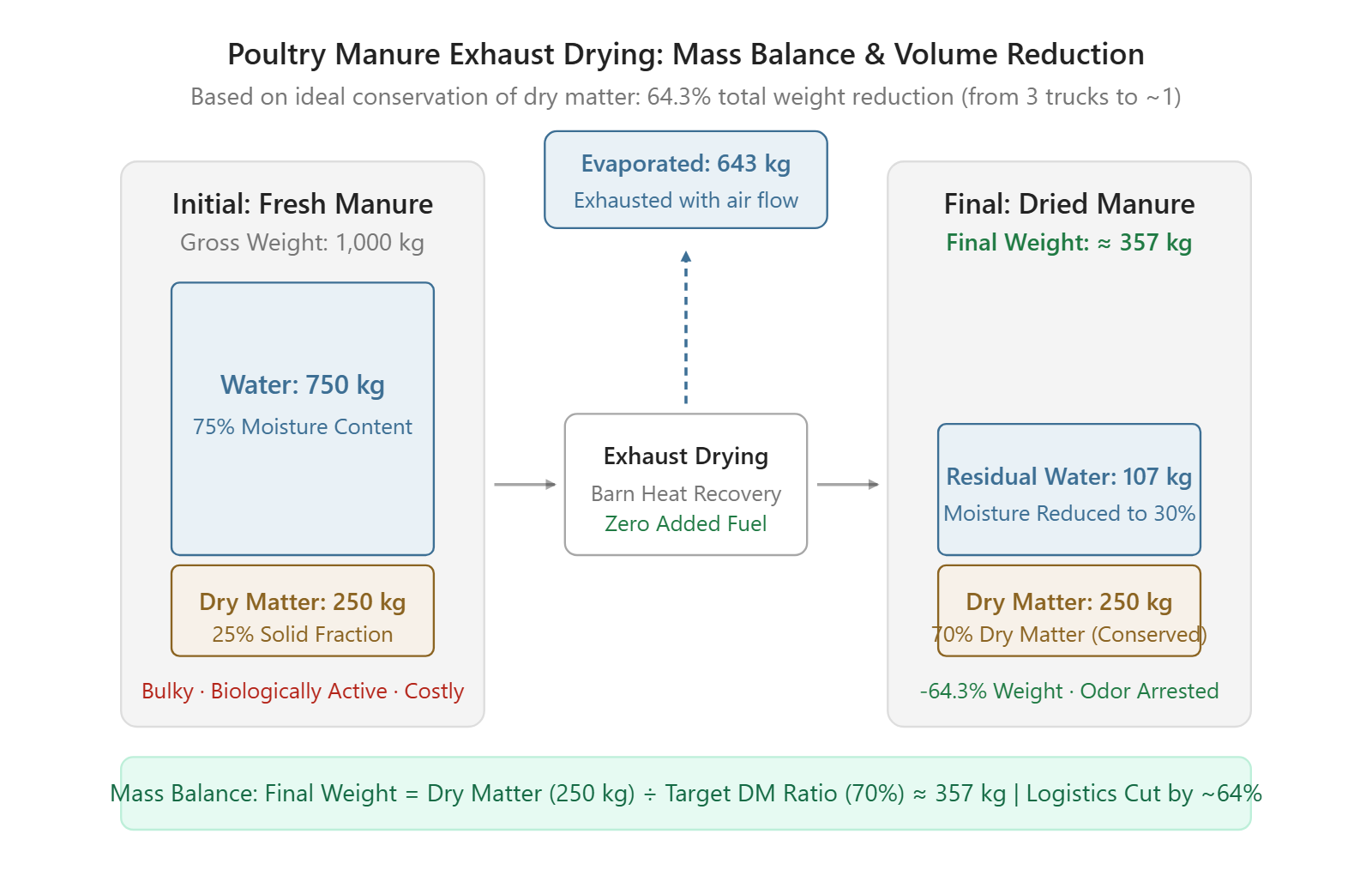
Initial State: 1,000 kg fresh manure @ 75% moisture content contains 250 kg dry matter and 750 kg water.
Dried State: When dried down to 70% dry matter (30% moisture), the final weight is calculated as:250kg
The Result: The original 1,000 kg is reduced to ~357 kg—a 64.3% overall weight reduction. Manure that previously required 3 collection trucks now fits into just over 1 truck, dramatically expanding distribution radius and lowering logistics overhead.
C. Biological Stabilization and EU BAT Compliance
EU Best Available Techniques (BAT) reference documents confirm that rapid drying immediately upon discharge arrests microbial activity. Reducing moisture below 60% substantially suppresses uric acid breakdown, drastically curtailing ammonia (NH3 )volatilization, odor nuisance, and nitrogen degradation.
5. Technical Transparency: Limitations and Engineering Considerations
A credible engineering solution must acknowledge operating limitations:
Seasonal Climatic Variations: Drying capacity depends on ambient temperature, relative humidity, and ventilation volume. During summer peak ventilation, drying is rapid; in winter, when minimum ventilation is engaged, drying rate drops. Precision sizing must calculate: Daily Manure Output x Initial/Target Moisture x Ventilation Volume X Psychrometric Conditions
Not a Thermal Pasteurization Process: Exhaust air drying stabilizes manure but does not achieve instantaneous pathogen kill (>70°C). If the end market demands certified sanitized pelletized fertilizer, secondary thermal treatment or aging is required.
Air Emission Management: Drying tunnels still exhaust residual ammonia and dust. In environmentally sensitive zones, downstream air scrubbers or bio-filters should be integrated at the exhaust discharge.
6. Summary: Good Equipment Should Not Force Farmers into a "Side Business"
For modern poultry farmers, the core mission is straightforward: raise healthy flocks and produce high-quality eggs efficiently.
Egg producers should avoid burdening their operations with the complex overhead of running an organic fertilizer fermentation facility or managing insect breeding.
An optimal manure management system must prioritize:
Minimal Daily Labor Intervention (Automated continuous operation)
Lowest Total Lifecycle Cost (TCO) (Leveraging free waste heat vs. continuous fuel purchases)
Maximum Volume Reduction at Source (Slashing storage and transport expenses)
Before investing in complex manure equipment, evaluate your true operational priorities. In commercial layer houses, putting your ventilation exhaust air to work one last time before it leaves the farm remains one of the most cost-effective and dependable engineering investments.
Ready to Optimize Your Poultry House Manure Management?
Contact our agricultural engineering team to run a customized psychrometric mass-balance calculation tailored to your flock size, barn design, and local climate.